
We are very pleased to announce that this year’s Waddington medal winner is James Briscoe. His fundamental discoveries have helped shape our understanding of of how morphogens work, and he has played numerous roles in promoting developmental biology in the UK and worldwide, as well as supporting early career researchers.
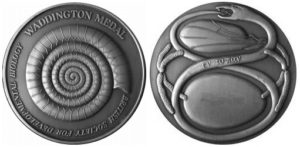 The Waddington Medal is the only national award in Developmental Biology. It honours outstanding research performance as well as services to the subject community. This year’s medal was awarded at the BSDB Spring Meeting at the University of Warwick where the recipient presented the Waddington Medal Lecture.

James Briscoe needs no introduction, as one of the most prominent developmental biologists in the UK. What we find surprising is that he has not yet been awarded this medal, as he fulfils all the expectations of awardees.
James was an undergraduate at Warwick where he studied microbiology and virology. He moved to the ICRF at Lincoln’s Inn Fields to work on interferons for his PhD, before joining Tom Jessell’s lab at Columbia University, where he started to work on the early development of the nervous system. He returned to the UK to become a group leader at the National Institute for Medical Research in 2000, later moving with the NIMR to the Francis Crick Institute. His work has focused on the development of the vertebrate spinal cord, using a highly multidisciplinary approach, with the specific aim of unravelling the classical question of how morphogens work, getting down to the nitty-gritty of the molecular mechanisms, while not losing sight of the bigger picture and the cellular and embryonic context. He has developed many new techniques which have themselves made a mark, always designed to answer a particularly difficult question, including the mechanism by which a cell integrates information from multiple signalling inputs to decide between alternative identities. His publications are characterised by their exceptional quality, and by the clarity of presentation and experimental design. He has also been keen to incorporate mathematical and computational modelling to explore the limits of the system and used these to predict the outcome of experiments. The few examples listed below provide a taster – perhaps his most important and elegant study is the demonstration of how a cell distinguishes between different concentrations (thresholds) of the morphogen Sonic Hedgehog to acquire different neuronal identities along the ventral-to-dorsal axis of the neural tube/spinal cord.
Appropriately, James has received many honours, including election as a fellow of both the Academy of Medical Sciences and of the Royal Society, and he is an EMBO Gold medallist.
As expected of the profile of Waddington medal winners, James has played numerous roles in promoting developmental biology in the UK and worldwide, as well as supporting early career researchers. He has been involved with the Company of Biologists for more than 20 years, first as a Director, and since 2018 as Editor-in-Chief of “Development”. In that role, he has been promoting the rejuvenation of developmental biology through appointment of new editors and editorial board members, as well as the introduction of a new section called “Meet the authors”, generally focusing on the younger members of the teams along with their PI. At the same time, he has been stimulating the publication of papers in currently trendy areas including stem cell biology, human development, mechanobiology and computational biology and modelling. He serves on multiple advisory boards and committees, and is an excellent mentor for members of his team and others. He is also an advocate of scientists from disadvantaged backgrounds or working in adverse conditions, a recent example being the last publication on the list below.
His upbringing was on a farm in the South of England, where he was surrounded by farm animals and has revealed at an interview in Development that he is even able to milk a goat!
We feel that James would be a perfect recipient of the 2026 Waddington medal.
- Claudio Stern
- Jim Smith
Key papers
J Briscoe, A Pierani, TM Jessell, J Ericson (2000) A homeodomain protein code specifies progenitor cell identity and neuronal fate in the ventral neural tube. Cell 101, 435-445
D Stamataki, F Ulloa, SV Tsoni, A Mynett, J Briscoe (2005) A gradient of Gli activity mediates graded Sonic Hedgehog signaling in the neural tube. Genes & development 19 (5), 626-641
E Dessaud, LL Yang, K Hill, B Cox, F Ulloa, A Ribeiro, A Mynett, BG Novitch, J Briscoe (2007) Interpretation of the sonic hedgehog morphogen gradient by a temporal adaptation mechanism. Nature 450, 717-720
N Balaskas, A Ribeiro, J Panovska, E Dessaud, N Sasai, KM Page, J Briscoe, V Ribes (2012) Gene regulatory logic for reading the Sonic Hedgehog signaling gradient in the vertebrate neural tube. Cell 148 (1), 273-284
D Benzinger, J Briscoe (2025). Investigating morphogen and patterning dynamics with optogenetic control of morphogen production. Developmental Cell (online August 2025: https://www.cell.com/developmental-cell/fulltext/S1534-5807(25)00495-2).
J Briscoe, CE Franklin, DA Gorelick, EE Patton, M Way (2025). Science under siege: protecting scientific progress in turbulent times. Development 152 (6), DEV204757