
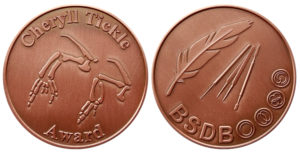
In 2016, the BSDB introduced the Cheryll Tickle Medal, which is being awarded annually to a mid-career, female scientist for her outstanding achievements in the field of Developmental Biology.
The BSDB is proud to announce the 2026 awardee is Prof. Cynthia Andoniadou!
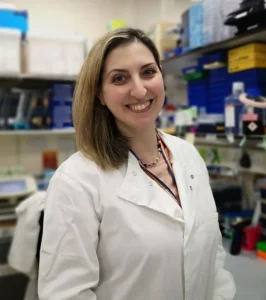
We are delighted to nominate Cynthia for her outstanding contribution to science and her extensive contributions to developmental biology.
Cynthia has established an internationally recognised research programme in pituitary gland development and stem cell biology, helping to redefine this field by revealing how developmental mechanisms govern tissue plasticity and disease. Her research has provided insights into the development of several congenital pituitary diseases (including pituitary hypoplasia, pituitary stalk interruption syndrome and Rathke’s cleft cyst). In addition, it has brought key mechanistic understanding for the pathogenesis of developmental pituitary tumours that present in childhood, providing a leading example of how developmental mechanisms become deregulated in cancer.
Her work identified SOX2⁺ cells as the functional pituitary stem/progenitor population orchestrating organ growth and differentiation and key signalling mechanisms regulating their fates. She demonstrated that pituitary stem cells control tissue turnover through paracrine signalling to neighbouring progenitors i.e. through feed-forward signalling, in addition to contributing new endocrine cells. Extending these findings to other endocrine organs, her team identified the postnatal stem cells of the adrenal medulla, redefining cellular hierarchies in adrenal biology and demonstrating that they share similar mechanisms for promoting turnover. These discoveries overturned long-standing assumptions of endocrine homeostasis and established a new paradigm for how adult stem cells can regulate organ maintenance.
Cynthia Andoniadou joined King’s in 2013, to investigate the stem cell compartment in the mammalian pituitary gland. In the last 12 years, since she established an independent lab, she has become a key player in pituitary research and extended to other endocrine systems. She is held in extremely high regard, due to her uncompromisingly high standards and seminal studies, becoming Dean of Research in 2025. Importantly, she has spear-headed effective collaborations with physiologists and clinical specialists, ensuring that her studies are translated, and have direct clinical implication. Her ability to combine mouse and human studies is exceptional – for instance, the human pituitary atlas is likely to becomes a world-wide resource. Cynthia is a great role model to her group and was awarded the prestigious KCL Supervisory Excellence award by her faculty, nominated by her students.
In addition to her research, Cynthia has been involved in learned societies. She was the Treasurer for the BSDB (2019-2024), in which time she interacted with the Company of Biologists and was able to juggle the funds of the society to support more students to attend meetings and learn through summer studentships. She is the Chair of the European congress of Endocrinology from 2022-2026 and co-founded the European Women in Endocrinology initiative (EUWIN).
Cynthia is an outstanding colleague – rapidly appraising a scientific problem, and coming up with possible explanations and hypotheses, and happy to share her time. Her hard work, her persistence and ingenuity will ensure that he will rapidly advance our understanding of important and fundamental processes in development and stem cells in endocrine organs.
In summary, I am certain that the strong career that Cynthia has already developed, through her love of science, will continue to flourish. She is a great example of the researchers we should be celebrating with awards such as the Tickle Medal.
-
- Abigail Tucker
- Tristan Rodriguez